























Ripple–Riyad Bank Blockchain Partnership Signals Institutional Shift
The partnership between Ripple and Riyad Bank indicates that Saudi Arabia’s financial sector is embracing blockchain-based infrastructure in a meaningful way.
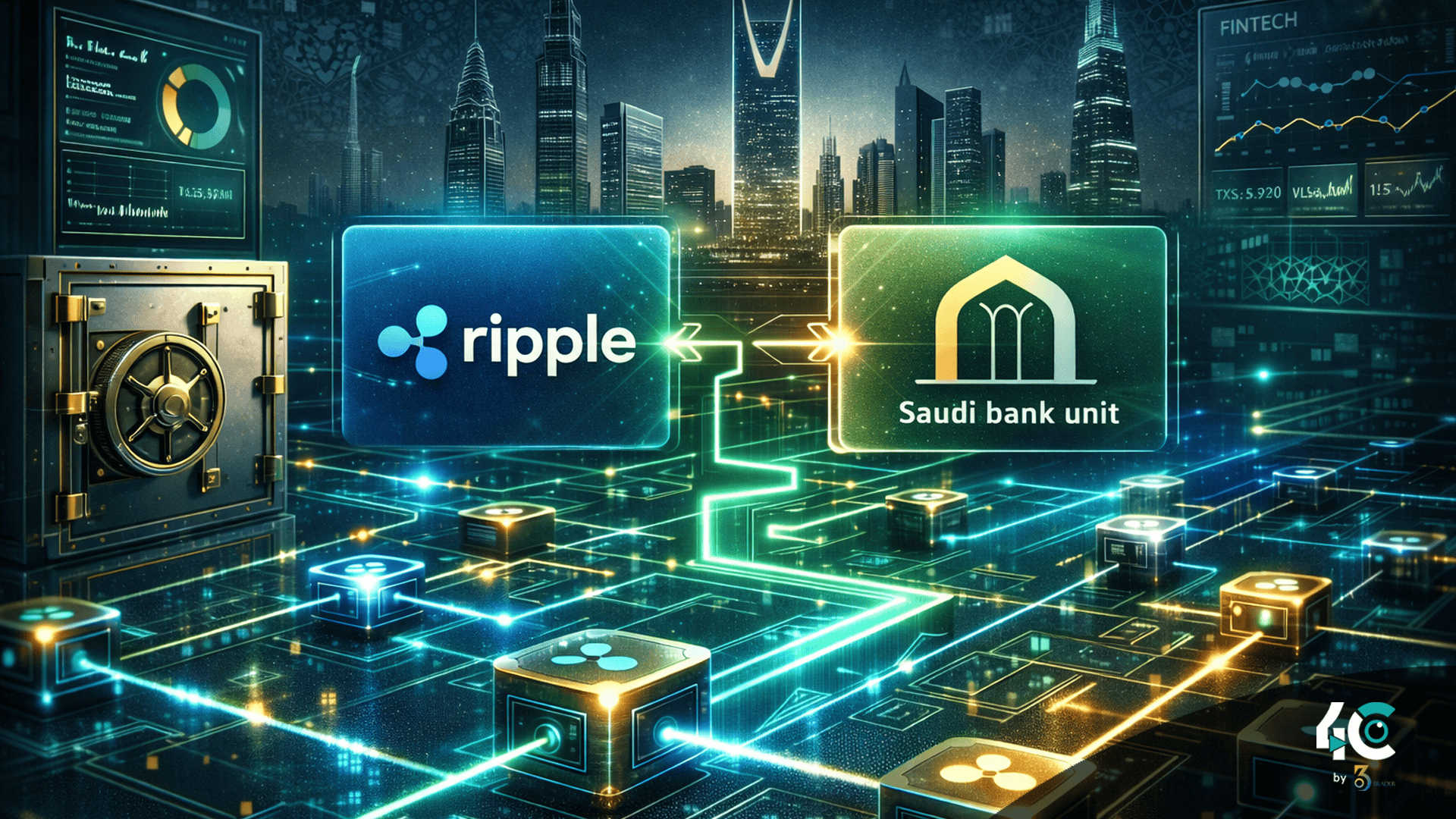
Ripple is now working with Jeel, the innovation unit of one of the largest banks in the kingdom, Riyad Bank, to examine how blockchain technology can be integrated into core financial functions. Reece Merrick, the Senior Executive Officer and Managing Director for the Middle East and Africa at Ripple, confirmed the partnership.
A Memorandum of Understanding (MoU) reflects growing institutional interest in viewing blockchain as a tool for financial modernization rather than a purely speculative instrument.
Focus on Payments, Custody, and Tokenization
Through the Ripple–Riyad Bank blockchain partnership, both parties will explore use cases across three key areas:
- Cross-border payments
- Protection and custody of digital assets
- Tokenization of assets
These initiatives directly support Saudi Arabia’s Vision 2030, a long-term national economic strategy aimed at diversifying the economy, modernizing financial infrastructure, and reducing reliance on oil revenues.
The partnership places blockchain technology at the center of future financial transformation, rather than on the fringes of experimentation.
Also Read : South Korea Lifts Ban on Companies Offering Cryptocurrency-Related Services
The Importance of Riyad Bank’s Role
The collaboration carries significant weight due to Riyad Bank’s position within the Saudi financial system.
With assets under management exceeding $130 billion around mid-2025, Riyad Bank is a cornerstone of Saudi Arabia’s regulated banking sector. The bank’s exploration of distributed ledger technology (DLT) signals that blockchain is moving closer to mainstream adoption within conventional finance.
Successful implementation could influence blockchain integration strategies among other major banks across the region.
The Middle East Accelerates Digital Asset Development
While Saudi Arabia has historically been cautious in adopting blockchain technology, the broader Middle East is rapidly gaining momentum, led by the United Arab Emirates.
Through the introduction of clear regulatory frameworks and close collaboration between regulators and industry, the UAE has positioned itself as a global digital asset hub. The region now hosts a new generation of financial services firms, with regulators increasingly acknowledging the role of cryptocurrencies and digital assets.
As a result, blockchain companies worldwide are seeking compliant access to Middle Eastern markets.
Ripple’s Stablecoin Initiative Expands Its Global Footprint
Ripple has already strengthened its regional presence, particularly in the UAE, where it received regulatory approval for Ripple USD (RLUSD)—a stablecoin designed for institutional payments and settlement.
RLUSD has grown rapidly, with circulation exceeding $1.3 billion, and the token now trading on major exchanges such as Binance. Over the past year, demand for regulated, enterprise-grade digital assets has risen sharply.
Tokenization Gains Momentum on Public Blockchains
Beyond regional developments, blockchain adoption continues to gain global traction.
The XRP Ledger recently surpassed $1 billion in on-chain tokenized assets, driven by tokenized U.S. Treasury instruments, other investment funds, and the increasing utilization of RLUSD. This milestone highlights how public blockchains are now supporting regulated, institutional-grade financial use cases.
Ripple–Riyad Bank Partnership Points to the Future of Finance
The Ripple–Riyad Bank blockchain partnership is far more than symbolic. It reflects a fundamental shift in attitude toward blockchain technology among large financial institutions.
Through this collaboration, Saudi Arabia can better align financial innovation with regulatory frameworks and national economic objectives, positioning itself as a meaningful participant in the future global financial infrastructure. As Vision 2030 accelerates, blockchain technology appears set to become a core pillar of the kingdom’s evolving financial ecosystem.